


EPISODE 101: THE JOURNEY STARTS HERE
Aired: August 04, 2026
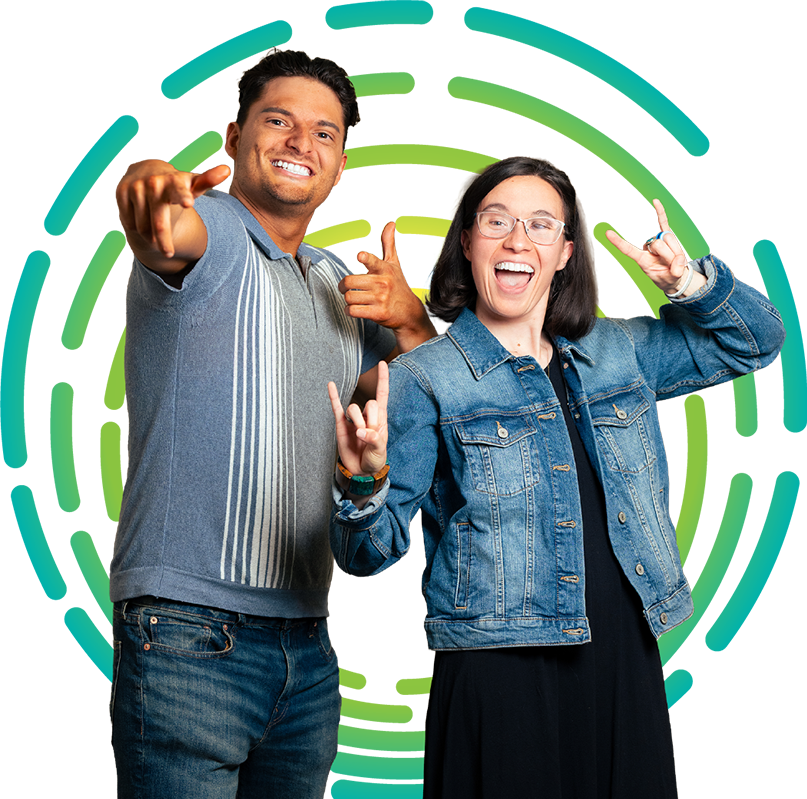
Asa Walden: Welcome, everybody. Welcome to the “Beam the Way” podcast. My name is Asa.
Alexis Juveland: My name is Alexis.
Asa Walden: And we are so excited to be here in “The RAD Position” studio to get started.
Alexis Juveland: You all are probably wondering, “What the heck is this podcast about?” Well, let me tell you. So, Asa and I are here to give a student's perspective, really, on what it's like to be a clinical student in a radiology program and give you a bunch of insightful tips from our perspective and about the lovely SLDP program that we're in.
Asa Walden: And if you're not familiar, SLDP stands for Student to Leadership Development Program, which is a function of the ASRT.
Alexis Juveland: So, we are so excited to provide insightful tips to students and new professionals alike about the SLDP program.
Asa Walden: So, without further ado, we're going to go ahead and let you know a little bit about ourselves and then we'll get started.
So, my name is Asa Walden. I am a student at Lanier Technical College in Gainesville, Georgia. And I have a background in behavioral health, specifically in substance abuse disorder with teenagers. So, this really shaped my approach to patient care. And I am also passionate about helping my fellow classmates. I believe that I have the best cohort in the entire world, and I like to do anything I can in order to help them.
Alexis Juveland: Well, a little bit about me. My name is Alexis Juveland. I am a second-year student at the College of DuPage in Illinois. And before being in school, I was an office and warehouse assistant for a nonprofit that supports the military. And one of the jobs that I had was assigning volunteers to help with community donations for our comfort and care package program that we sent overseas to deployed troops. So, I really enjoyed doing that.
And then seven months before I actually started the radiography program, I — and I still am — but I was a full-time patient transporter for a hospital. And that has been an amazing experience in itself. And being able to meet people where they're at, especially in probably one of the worst times of their life, it's a very humbling experience. And knowing that the conversations that you have with people can change their entire mood and perspective on the world.
Asa Walden: I think we share that passion. So, I really enjoy that you share that outlook as well, so.
Alexis Juveland: Thank you very much.
Asa Walden: Yeah. So, we don't want this podcast to just be all about us. We also want this to be a place where you feel comfortable reaching out to us if you have any questions.
Alexis Juveland: Absolutely. The SLDP program and this podcast itself is a great way to challenge yourself and be open to new opportunities, because the ASRT wants you to succeed and they want you to know that. And we want you to know that you are valued.
Asa Walden: And, trust me, we're aware that it's very difficult to start out in a new field. So, we want you to feel comfortable reaching out to us if you need support.
Alexis Juveland: Absolutely. You know, every technologist was once in our shoes, and so we get to share that experience right now of having the stress of clinicals, having the stress of school and having that work-life balance. So, it's really an amazing opportunity for us to share our perspective with you guys.
Asa Walden: Yeah, that transition is not easy. I feel sometimes like I am in between worlds. We're graduating soon, right? And we're super excited about our new career, and so, that transition can be difficult for a lot of people. We're here to just give you any support that we can.
Alexis Juveland: Absolutely. This podcast is a great way for students and new professionals to become more educated about the field itself and ways to be involved, because there's so many resources that the ASRT offers that so many don't realize. So, I'm so excited to share those tips, and this podcast is really going to be a gem for students. So, it's going to be really exciting.
Asa Walden: Yes, this profession goes far beyond taking x-rays. We're really here to share our experience doing the extracurricular stuff. Doing the extra stuff is what makes this career special.
AI Marie: Hey, what about me?
Asa Walden: Uh-oh, that sounds like Marie.
Alexis Juveland: Marie is going to be our personal virtual assistant for the podcast.
AI Marie: I'm quite humorous for an AI [artificial intelligence], as in h-u-m-e-r-u-s.
Asa Walden: Oh, Marie.
Alexis Juveland: Ah, always coming up with her funny jokes.
Asa Walden: The first training dataset that they used was definitely an anatomy textbook.
Alexis Juveland: [laughs]
AI Marie: I was bone to be wild.
Asa Walden: [laughs]
AI Marie: Get it? Bone, not born. I crack jokes, and bones crack, too.
Alexis Juveland: Yes, they do. They do indeed.
Asa Walden: One thing about Marie: She will be correct. Technically.
Alexis Juveland: [laughs] Technically speaking, yes.
Asa Walden: Marie, go ahead and get us ready for our first interview.
AI Marie: Queuing our first guest on the “Beam the Way” podcast.
Alexis Juveland: We have a very special guest who I'm so excited to introduce, who's the ASRT president, Miss Marissa Mangrum. Welcome.
Marissa Mangrum: Yeah, thank you for having me. I'm so excited to be here.
Asa Walden: We're excited to have you, Marissa. So, our first question for you is why should students become future members of the ASRT?
Marissa Mangrum: Oh, wow. I think it's so important. I speak from my journey. I was a member as a student and went to my first conference as a student, and that kind of lit my fire to continue volunteering. And I saw — you know, I had mentors, and it led me to this position. So, I'm always very passionate with my students — so I'm an educator as well — that they should be involved. You are the ones that make the decisions about the professions. Like, I didn't even realize that when I was a student that, wow, these are some people out there like you'll see at the [ASRT] House of Delegates. There are people making decisions for the profession, and that can be you.
Alexis Juveland: Absolutely. I would say it's so important to start early, because every tech was once in our shoes. So, it's really great to get that start.
Asa Walden: They might like to pretend that they forgot that, but they did not forget that.
Alexis Juveland and Marissa Mangrum: [laugh]
Alexis Juveland: Absolutely. Marissa, I want to dive a little into your role as president and discuss what your priorities are and how something like this podcast fits within your initiative.
Marissa Mangrum: Well, I have three priorities that I'm focusing on this year. My first is mental health and burnout prevention. You know, that's really important to me. I heard a student stand up at the House of Delegates meeting and say that they are seeing burnout in the clinic, when they're in their clinical rotations. And I hated that because it's
already giving like a negative, you know, a negative view of the profession. So, I thought that's a big problem not only in our clinics with our technologist, our therapist. It's an issue that's affecting the students. So that's my first that, you know, that focuses on not only the technologist, therapist, but the students.
Also for radiation — I am a radiation therapist — and be looking at different educational, cancer education models, emerging therapies and advancement of that discipline.
And then with students. I'm very focused on students. I'm very — like I said, I am an educator. I'm a program director. I have known I've wanted to be a educator since I was a student. Like, that was something that I was like, “I'm so passionate about this. Let me be an educator.” So, I worked in the clinic for several years, and then I became an educator.
And what is important about this initiative is to get you guys involved more. So, this podcast is part of that. Like, I think it's so important for you to know that we want you here, and this is — we want you involved. We want you, you know, a team approach. We want you guys to — because you are going to be the ones making a difference.
As a Board [of Directors of the ASRT], a lot of the decisions we make are things that might not happen today, but they're going to affect you. They might happen next year or the year after or even further down the road. So, it's very important to me for you guys to be involved.
Asa Walden: Absolutely. Efforts and and advocacy campaigns, they don't happen overnight, that's for sure. In Georgia, we just got registered radiologist assistants licensure legal, and that was a five-plus-year effort.
Marissa Mangrum: Oh, yeah.
Asa Walden: And so, we have those days that we go to the Capitol, and it's a group effort. So, it is definitely something that happens over time, and it's not something that one person makes happen. It's a collective effort.
Marissa Mangrum: Yes.
Asa Walden: And I really appreciated you mentioning burnout because that is a real problem not only in imaging but in the medical field in general. There's a huge burnout issue. So, I would love to know if you have any specific assignments for our listeners to help overcome burnout, any practices. What would that assignment be?
Marissa Mangrum: You know, I think we've lost a lot of, like, things, knowing even what our passion is outside of work, outside of school. You know, taking time every day to do something you enjoy. Even if it's 30 minutes, you know, I tell my students, “Don't stop exercising. Don't stop doing the things you enjoy.”
Alexis Juveland: Yes.
Marissa Mangrum: You know, because then it will turn into burnout. So, taking that time and not — I think, you know, when people are like, "No, I've got to study. No, it's 30 minutes. I'm so busy” — how long do we scroll on our phones, right? And that doesn't — you know, and I do it, too. It seems like it's relaxing. You know, I go lay down in the bedroom and just start scrolling. It's an hour later, where I could have done something that revived me more or went for a walk or played with my dog, did these other things.
So, remember what is important to you and still do that thing. Don't let it fall to the side because you think you're too busy, because I guarantee you're not.
Alexis Juveland: Absolutely. I think self-care is so important, because it can feel isolating at times, feeling in the program, and you don't want to have that burnout, that crash and then — because it'll really affect you going forward.
I would say besides the tips for burnout, what other advice would you have for students and those who are new to the profession?
Marissa Mangrum: Get involved. That's my biggest thing. Like, get involved. Come to the conferences. Talk to people who have been at a conference. Find out — like, look at the social media that they're posting from the — it's such a great environment, and it's energizing. That's how everybody starts. And the longer you're involved from the get-go, the better.
So, you know, we have a lot of student programs where you get involved, right? The SLDP. And then you can just continue. And that's where a lot of people started from that are in leadership. I'm too old, like, they didn't have that one when I was a student at the time, but still, just seeing mentors and having mentors and — Alexis, I know you have a mentor that I know it's kind of a full circle.
Alexis Juveland: I do. I do.
Marissa Mangrum: So —
Alexis Juveland: Give a shout out to Mandy [Amanda] —
Marissa Mangrum: Hanstein. Yeah.
Alexis Juveland: — Hanstein. Yes. She is an absolute gem. She's such a wonderful mentor. I'm so lucky that I got paired up with her.
Marissa Mangrum: And a funny story about that is she was my former student —
Alexis Juveland: Oh, no way.
Marissa Mangrum: — and that's how, so I feel like I've been a mentor to her. She was my former student, and I actually called her up one day and was like, "Hey, you know, I think you'd be great being a faculty member and, you know, it's an open position." So, she applied and everything, and now she's worked there for, oh, coming on five years.
Alexis Juveland: Wow.
Marissa Mangrum: So, it's — yeah it's wonderful, so.
Asa Walden: So, one might say in a sort of roundabout way you are being mentored by the president of the ASRT.
Alexis Juveland: Exactly. Full-circle moment we got going on.
Marissa Mangrum: [chuckles]
Alexis Juveland: That's awesome.
Asa Walden: Becoming involved in the profession has lots of benefits. What have you enjoyed about being part of the ASRT Board of Directors?
Marissa Mangrum: I never intended for that to be my endpoint getting into leadership. Like, I really love what I do. I love being a volunteer. So, you know, the whole process of being able to talk to more people, network with more people and just, you know, learn about all the disciplines in our profession is just incredible. So, pretty much love every minute of it, really.
Asa Walden: And why is it important for ASRT members to run for the Board of Directors?
Marissa Mangrum: Because, like I mentioned, it's the members who make those decisions, right? It's everybody involved. It's those at the House of Delegates. So, it's very important because we need different perspectives. You know, it doesn't need to just be educators. We need people that are working in the clinics every day. We need full perspectives and we need all the different disciplines on those Board of Directors so we can lead the profession as a whole.
Asa Walden: Well, Marissa, it has been an absolute pleasure to meet you. Thank you so much for being our first guest on this wonderful new podcast, and we just want to thank you again for taking time out of your busy schedule to meet with us.
Marissa Mangrum: Thank you, guys. This has been so fun. I've enjoyed it so much.
Alexis Juveland: Thank you, Marissa.
Asa Walden: You know, Marissa was a lot easier to talk to than I expected. When I heard “president of ASRT,” I was expecting someone a little bit more intimidating.
Alexis Juveland: Absolutely. She was so, you know, forthgoing. She was so relaxed. You know, it was just like a conversation, a normal conversation with her. And I'm so happy of all that she brought up. And you just know, even though despite the position she has, how supportive she is for people just starting out in the profession. And you can tell that she really wants them to succeed.
Asa Walden: Right, it's a really good reminder that people high up in the Society are also just people. They're just people that started out in this field like you and I did. You know, we're students, we'll be professionals and then we choose to do the extra stuff and that will bring us to those leadership positions. It's not something that you just kind of luck out on. She's just a normal person that decided to go the extra mile again and again and again.
Alexis Juveland: Absolutely. And this, like, the SLDP program, like she said, a lot of the people who are on the Board of Directors, in higher up positions for the ASRT. So, it's a really great way to become involved within the profession as a starting point.
Asa Walden: Absolutely. So, thanks again, Marissa, for joining us.
Alexis Juveland: Next up, guys, during this podcast, we're going to have different segments to show you that will be really educational about the ASRT and how they can benefit you. The first one we'll be starting off with is Starting Out Strong With Bianca.
Bianca Strong: Welcome to Starting Out Strong With Bianca. I'm excited to introduce to you the Student to Leadership Development Program, or SLDP. This is a three-year program that offers students a chance to get to know the ASRT, attend educational sessions and network with medical imaging and radiation therapy professionals.
Online course topics include an overview of governance, parliamentary procedures and advocacy, strategic planning, legal issues, association management communication and, of course, leadership principles. Selected participants receive an educational program designed just for students, an insider’s look into the world's largest association for medical imaging and radiation therapy professionals, and expanded opportunities for professional growth. So, let's finish out strong. Learn more by visiting our website, asrt.org/SLDP.
Asa Walden: We are extremely honored to be a part of that program. So, throughout this podcast, we're going to be giving you a little bit of more details about how to apply, what it's like to be a participant and that sort of thing.
Alexis Juveland: And the SLDP program really acts as a foundational base and a great start to your career. One of the amazing opportunities that we have is to attend the House of Delegates meeting in our first year, which I am so excited about. There are going to be so many different networking opportunities for us, and I'm just so excited to meet people, get different people's perspective about our program, about different regulations within their state as well.
Asa Walden: Each state has its own society, right? So, you have the officers from each state society all coming together for one week. It's a really cool way to see at the national level how decisions are made that will impact our everyday lives as professionals in the medical imaging and radiation therapy field.
Alexis Juveland: Absolutely. I think being able to see live, in person, what the ASRT does and what they are doing at their core to protect and defend our profession is so rewarding. And in a way, I really think that it could inspire us to want to go that extra mile, to become more involved, to go into those volunteer positions because that could be us one day as leaders. These people were once in our shoes. They had to start at the very base. And we have the equal opportunity to do it just as well.
Asa Walden: And it doesn't look too bad on a job application either, right?
Alexis Juveland: It sure doesn't.
Asa Walden: [laughs]
Alexis Juveland: No, not at all. I think just this program alone will make you so much more desirable for potential future employers.
Asa Walden: And medical imaging and radiation therapy professionals are already in such demand that the sky's the limit if you have an extra thing to put on your application. This really just takes you to that next level. You can pretty much get a job anywhere, so.
Alexis Juveland: Absolutely. Some other sections of the SLDP program that I would really like to highlight are having a professional mentor your first year, which has been so helpful. I love my mentor, Mandy. She is a gem. I could not have been lucky enough to be partnered with her. She gives me such great advice, and I could tell she's really there to support me. Can you tell me a little bit about your mentor?
Asa Walden: Yes, my mentor's name is Lynn [Clavijo], and I chose her specifically, one, because she is located geographically close to me. She's in Atlanta, and I go to school in Gainesville. So, I actually have the opportunity to meet her in person, which is really cool.
Alexis Juveland: Amazing!
Asa Walden: Yes. I met her at the Atlanta society meeting where I was doing a presentation on radiation safety throughout the decades, and she came to support me. And what's really cool about having a mentor that's local is that she can give me advice that's specifically tailored to my future career as someone that's living in Georgia.
So, she has worked the out-of-the-box careers, and that's the other reason that I chose her, because there is all sorts of jobs that we don't even learn about necessarily in school. And that's why I chose her, because I want to know about all the opportunities that exist out there, not just what's expected of me.
Alexis Juveland: That's awesome. That's really great. I think this professional mentorship program [Professional Mentor Program] was a great idea. And especially I like how you get different perspectives whether you're in the same state as your professional mentor or within a different state as well.
When I have talked with Mandy at times, she tells me how you don't need licensure, I believe, to be an R.T. [radiologic technologist] in Oklahoma, but in Illinois, you do. So, it's really interesting to get that differing perspective and how the regulations work differently.
Asa Walden: That is a whole conversation and a half if you want to get into whether or not you need licensure to get a job.
Alexis Juveland: Yep. Yep.
Asa Walden: So, it's actually the same in Georgia. You don't technically need licensure in Georgia. It's going to be a lot harder to get a job if you don't have “R.T.(R)” [the credential for an American Registry of Radiologic Technologists-registered technologist certified in radiography] behind your name. But the fact that you don't legally need licensure in order to take x-rays is sort of like a very controversial thing right now that the Georgia society [Georgia Society of Radiologic Technologists] is actually taking steps to sort of correct that, because it's so important to have adequate training in radiation safety if you're going to be administering ionizing radiation. It literally changes your cellular structure, right? So, it's so important —
Alexis Juveland: Absolutely.
Asa Walden: — that we have competency, right?
Alexis Juveland: Speaking of licensure, Asa, we're going to move on to our next segment now. So, let's watch Checking In With Check.
Meredith Check: Hey everyone, my name is Meredith Check. I'm the director of government relations and public policy here at ASRT. And this is Checking In With Check, a time where we're going to talk about advocacy, how to engage and what ASRT does to promote the profession.
So, what is advocacy? It is simply a place and a time where you get a lot of people together to advocate for a particular issue, so, whether that's to support or defend or promote a specific policy issue. So, the really cool thing is that advocacy is protected under the Constitution. Right there in the First Amendment, it says that Congress shall pass no law that prohibits the people from petitioning the government for redress of grievances.
Well, that's Checking In With Check. Until next time.
Voice-over: MARCA [the Medicare Access to Radiology Care Act] has now been introduced in both the U.S. Senate and U.S. House [of Representatives]. And now we need your help. This important legislation supports patient access to radiology care and recognition of radiologist assistants. Contact your representative and senators today and ask them to support MARCA. Your voice can make a difference. Visit the ASRT Advocacy Action Center to take action.
Asa Walden: Alexis, what did you know about advocacy before you started the radiography program?
Alexis Juveland: With regards to advocacy, not very much, to be honest with you.
Asa Walden: I'm in the same boat as you. I had no idea what it was. I've heard the term lobbying before, but I hadn't heard of advocacy specifically.
Alexis Juveland: Absolutely. And I've heard of groups going to the state capitols for whatever they're passionate about, but I never knew that you could do it for the radiology profession. So that was pretty awesome to hear.
You know, the video with Meredith is really reminding me of two different bills in our state that are trying to be introduced. My clinical coordinator actually introduced me to advocacy because she's very passionate about it. And keep in mind, she's also the president of the Illinois state society [Illinois State Society of Radiologic Technologists]. So, you know she was hounding students in my program about it. And what — it's actually an amendment to the Nurse Practice Act and the Radiation Protection Act. And what they're trying to do is allow advanced nurse practitioners to administer radiation to patients.
Asa Walden: OK. How do we feel about that?
Alexis Juveland: Exactly. It's definitely an encroachment, and it can really put the jeopardy of radiologic professionals in jeopardy for the future.
Asa Walden: That's crazy because it made me think of the bill in my state, House Bill 571, that we actually got passed this year and I was a part of it. I went to the —
Alexis Juveland: Amazing. [claps]
Asa Walden: Thank you.
Alexis Juveland: Yes.
Asa Walden: I went to the state Capitol. I personally met with senators and representatives. I even spoke with Senator [Steve] Gooch, who represents my hometown, my actual district that I live in. And they seemed really receptive to the bill.
I explained to them the importance of having registered radiologist assistants in Georgia and how it could really bring medical care to lower income specifically, because radiologist assistants are midlevel providers. So, you have a lot of low-income areas that have clinics that can't afford necessarily to have on-staff physicians, but if they have a midlevel provider, then these people can still get — they can still get medical imaging.
So, it is very cool that we got it in Georgia, and I personally felt honored to be a part of that, and I could really feel the impact of my efforts. So cool.
Alexis Juveland: Absolutely. That's amazing. And I think hearing your story at the Capitol is a real testament to show that, how impactful our voices can be for the future of this profession. And you can just start out as a student, and you have the power, you have a voice to be able to educate lawmakers about why it's so important to protect our patients and to provide quality patient care.
Asa Walden: Plus, the state Capitol is just really cool. It was just a really cool experience to get a tour —
Alexis Juveland: Yeah, that’s an added benefit.
Asa Walden: — look up at the huge dome ceiling. It was just really cool. So, yeah.
Alexis Juveland: [laughs] That's great.
Asa Walden: You know, and speaking of tours, we are at the ASRT main office, where we have the ASRT Museum and Archives. So, we're going to go ahead and go over to Museum Moments With Bill.
Bill Brennan: Hi, I'm Bill Brennan, the executive director of the ASRT Museum and Archives, and welcome to our series, Museum Moments. Today, and in subsequent episodes, I hope that we can highlight for you some of the more unique artifacts that we have here at the ASRT Museum and Archives.
You know, many of us, when we went to x-ray school, learned all about the physics and we learned about technique and positioning, but we don't always learn about the history of radiology. And, you know, I've always said that you don't know where you're going till you know where you've been. So, it is our hope that we can show you where we've been so that you will better know where you're going.
Here at the ASRT Museum and Archives, we consider ourselves the stewards of the profession. Did you know that we have over 2,000 artifacts located here at the ASRT Museum and Archives in Albuquerque [New Mexico]? We're hoping that someday you can come in person and visit. Well, anyway, I'll see you next time here on Museum Moments.
Asa Walden: OK, first impressions: He is so cool. That bolo tie? Perfection.
Alexis Juveland: You know, I can just tell from this clip alone, like, how great of a tour guide Bill would be. Just seeing —
Asa Walden: Can we do a tour right now?
Alexis Juveland: — the excitement, you could tell, like, he has a true desire to want to teach others. Bill —
Asa Walden: Yes.
Alexis Juveland: — what a gem.
Asa Walden: Mark my words —
Alexis Juveland: What a guy.
Asa Walden: — we are going to his tour before we leave here today.
Alexis Juveland: [chuckles] Absolutely. Yes.
Asa Walden: One of my favorite courses was called Biological Effects of Radiation. And the coolest part about that course was that we learned about the history of radiation safety, how it was sort of like a trial by fire.
Alexis Juveland: Ah, very nice. You know, and I'm excited to learn all about that within this museum. I think it's going to talk a lot about obviously the history of radiology and the trial and errors that they've gone through to bring us here today.
Asa Walden: I agree. It's really easy to take our modern equipment and our safety standards for granted. It's easy to forget that they are all there for a reason. Every rule, every regulation, every piece of safety hardware that we employ every day. It's there because at one point they didn't have it and something bad happened. So, it's actually very fascinating to learn about why every single thing we use every day has sort of like an origin story, you know?
Alexis Juveland: Absolutely.
Asa Walden: Well, Alexis, I'm really excited to be on this journey with you. I can't wait to learn more about you and your program and just find out what is different in a different state, right? Because I'm so — I feel like I'm in this little bubble of my school and my program. So, I think it's just going to be a breath of fresh air to learn about how a school in Illinois does it, for example.
Alexis Juveland: Absolutely. And I'm so excited to hear about your program and how we can compare and contrast it and just about the podcast in general. I'm really excited about all the opportunities we'll be able to educate students and new professionals alike and just be able to grow this amazing community for medical imaging and radiation therapy professionals.
Asa Walden: Yes. The overarching theme I saw was that in this field, you get what you put into it, right?
Alexis Juveland: Absolutely.
Asa Walden: So, if you want to go above and beyond, the opportunities are out there.
Alexis Juveland: Another thing that we would like to share with you guys is a poll that we sent out to the ASRT social media pages, and we wanted to hear your feedback about some questions. Our first question that we wanted to ask you guys: What part of the SLDP program are you the most interested in? Option one: learning about governance and advocacy. Option two: professional mentorship program [Professional Mentor Program]. Option three: networking. Or option four: attending the House of Delegates.
And the winner, drumroll [whoops] — 41%: the professional mentorship program. I would have to agree. I would have to agree. Although for me, the House of Delegates meeting, attending that, is pretty close up on my list.
Asa Walden: You know, that's what I was going to say. I was surprised that more people didn't vote for attending the House of Delegates meeting.
Alexis Juveland: When I really think about it, students who are really new to maybe health care in general or radiology, really trying to get their foot in the door, I think it's really encouraging to have someone like a mentor have your back and be able to support you and give you advice when you're questioning yourself, you may have doubts, and just having that support system.
Asa Walden: Oh, it's invaluable, because the one thing that you're lacking when you enter a new field is confidence. And if you have someone that's well established in the field and they can tell you definitively you are doing the right thing right now, it just gives you more confidence, right?
Alexis Juveland: Absolutely.
Asa Walden: So, subscribe. Thank you again for listening or watching. We can't wait to share this again with you.
Alexis Juveland: And remember, we're all in this together —
Asa Walden: — one beam at a time.